Sarasota Flood Zones Insurance for Coastal Buyers
If you are buying or selling near the water in Sarasota, flood insurance can feel like one of the hardest parts of the process to understand. You want clear answers on risk, coverage, and monthly ownership costs, especially in coastal areas where one street or even one parcel can differ from the next. The good news is that flood zones and insurance are manageable when you know what to check early. Let’s dive in.
Sarasota County updated its FEMA flood insurance rate maps effective March 27, 2024, using newer scientific and technical data. According to Sarasota County’s flood map update notice, those changes can affect insurance requirements and premiums, even though they do not change hurricane evacuation levels.
That distinction matters if you are comparing homes along Sarasota’s barrier islands or other coastal areas. A property’s flood zone can affect lender requirements, construction standards, and insurance pricing, but it does not tell the full story by itself.
One of the biggest mistakes buyers make is assuming a whole neighborhood has the same flood profile. In Sarasota’s coastal markets, nearby parcels can fall into different zones or wave-hazard areas, which is why the safest approach is to verify each property individually.
The county’s flood maps page lets you search by address or parcel ID. Sarasota County also notes that flood conditions can change over time due to development, environmental impacts, and shifting floodplains, so older assumptions may not reflect the current map.
You do not need to memorize every FEMA label, but it helps to know the basics when reviewing a listing, an insurance quote, or lender paperwork.
Zone A and Zone AE are considered high-risk floodplains with a 1-percent annual chance flood. Sarasota County notes that mandatory flood insurance purchase rules generally apply when there is a federally backed mortgage.
The difference is that AE includes detailed analysis and base flood elevations, while Zone A does not show those details in the county summary. If you are comparing two similar homes, that added elevation information can be useful when evaluating compliance and insurance questions.
Zone AH involves shallow flooding, usually ponding, with average depths between 1 and 3 feet. Zone AO also involves shallow flooding, but it is usually sheet flow on sloping terrain.
For AO areas, Sarasota County says the lowest occupiable floor must be at least 1 foot above the minimum flood depth shown on the map. That can become an important detail if you are reviewing renovation history or asking about future improvement plans.
Zone VE is a coastal high hazard area where storm waves and fast-moving water can cause extensive damage. FEMA explains on its coastal flood insurance rate maps page that VE is specific to coastal areas, and Sarasota County notes that homes in VE zones must meet stricter elevation rules.
A VE label does not automatically mean a property is uninsurable. It does mean you should take a closer look at elevation, foundation type, and construction details before you move too far into a purchase.
In some coastal areas, you may also see a LiMWA, or Limit of Moderate Wave Action. Sarasota County explains that this line marks the inland limit of the approximate 1.5-foot breaking wave.
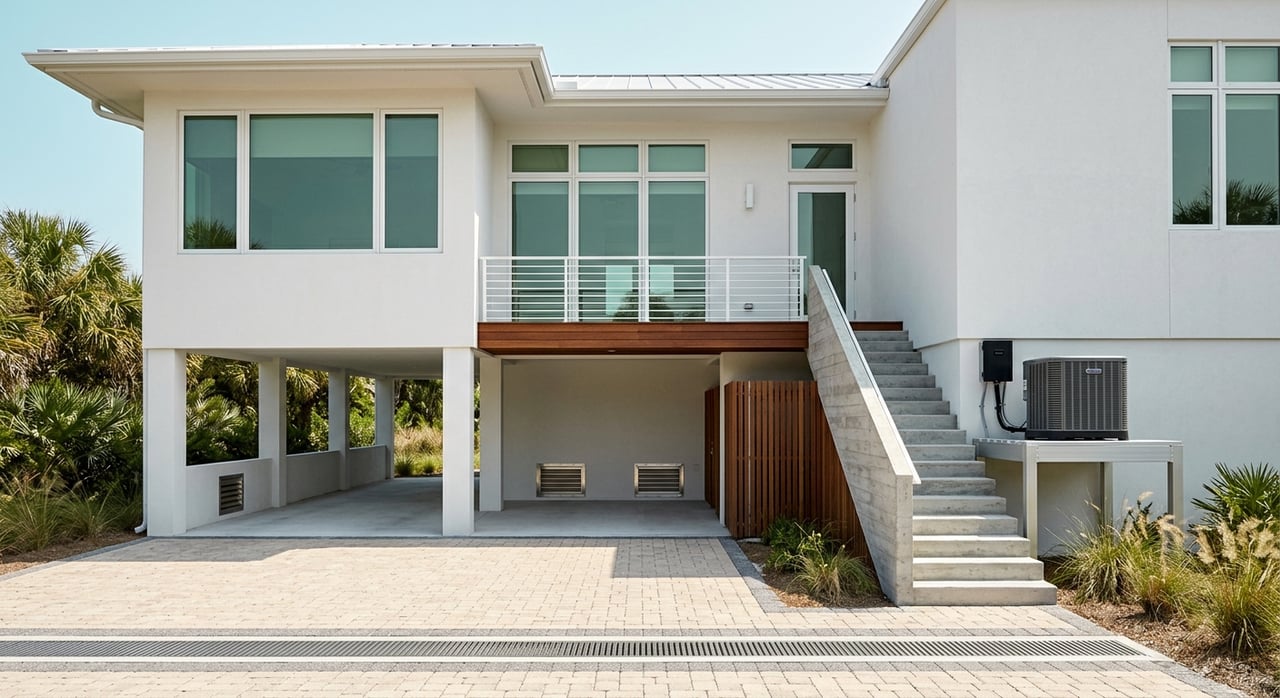
If a structure is seaward of the LiMWA, it generally must be elevated on piles or an engineered stem wall that can resist design flood forces. This is one reason two waterfront homes with similar views can have very different insurance and resiliency profiles.
Zone X and X500 are lower-risk categories, but they are not no-risk categories. Sarasota County says unshaded Zone X is minimal risk, while shaded Zone X and X500 are moderate-risk areas tied to the 0.2-percent annual chance flood.
That is why it is important not to treat Zone X as a free pass. The county specifically cautions that all properties in Sarasota County have some element of flood risk.
A common point of confusion for coastal buyers is that flood coverage is usually not part of a standard homeowners policy. FEMA states on its flood insurance overview that flood insurance is a separate policy and can cover the building, contents, or both.
Florida’s Department of Financial Services also notes that some private insurers may offer flood coverage as an endorsement. In practical terms, you should review homeowners coverage, flood coverage, and wind or hurricane costs as separate parts of your ownership budget.
Flood is only one piece of the insurance picture in Sarasota’s coastal areas. Florida DFS explains in its natural disaster consumer guide that residential property policies generally must include windstorm coverage, except in limited coastal areas, and that hurricane losses are subject to a hurricane deductible.
That deductible can be significant because insurers must offer options of $500, 2 percent, 5 percent, or 10 percent of the dwelling or structure limit. On higher-value coastal homes, that can have a major impact on your cash exposure after a storm.
Many buyers assume the flood zone alone determines the premium. FEMA says that is no longer the case under its current pricing approach.
As explained in FEMA’s single-family home pricing factors guide, pricing can also reflect elevation, distance to water, flood type, replacement cost, building characteristics, and mitigation features such as flood vents. That means two homes in the same neighborhood, or even the same flood zone, can have very different premiums.
Sarasota County has participated in FEMA’s Community Rating System since 1992. FEMA says on its CRS program page that communities in the program can receive flood insurance premium discounts ranging from 5 percent to 45 percent, depending on community class.
For you, that means local participation in floodplain management and public outreach may help reduce policy costs. It is still smart to ask your insurance contact whether the property benefits from the county’s CRS-related discount structure.
Flood insurance should be discussed early, not at the end of the contract period. FEMA says NFIP policies usually have a 30-day waiting period before they take effect, with certain exceptions for some mortgage-related purchases and map-change situations.
That timing can matter if you are under contract on a coastal property and trying to line up coverage before closing. Bringing insurance into the conversation early can help you avoid last-minute surprises.
An Elevation Certificate shows how high a building sits relative to expected flood levels. According to FloodSmart’s Elevation Certificate resource, the document can help insurers assess risk and identify discounts, but it does not set the rate by itself.
FloodSmart also notes that most homeowners do not need one, though homes in higher-risk Zone A or Zone V often need it to verify compliance. If one already exists for the property, it can be a helpful document to request early in your due diligence.
If you are considering a home in Sarasota’s coastal areas, these are some of the most useful questions to ask before you close:
These questions can help you move beyond the listing description and focus on real ownership costs.
If you are selling a coastal property, being organized can make the process smoother for buyers. Sarasota County notes that insurers may request a new FEMA Elevation Certificate after map changes become effective, so it helps to keep prior flood documents, permits, and elevation records together.
Sellers can also benefit from knowing the property’s current map designation before listing. When buyers ask informed questions, clear documentation can support confidence and reduce back-and-forth during escrow.
Another important point is what happens after a major flood event. FEMA explains on its Increased Cost of Compliance page that if a home is substantially damaged by flooding, local officials may require repairs or rebuilding to current flood standards before the structure can be used again.
FEMA also notes that NFIP policies include Increased Cost of Compliance coverage for some code-required mitigation work. This can affect your total post-storm costs even if insurance pays part of the claim.
Before you rely on marketing remarks, old insurance paperwork, or word of mouth, check the official sources. Start with Sarasota County’s flood maps and parcel search tools, then compare that information with lender and insurance documents.
If the property is near the coast, confirm whether a LiMWA appears on the map and whether an Elevation Certificate is available. A little extra review upfront can make a big difference in how confidently you buy or sell.
If you want help evaluating coastal ownership questions in Sarasota, from parcel-level flood map context to how insurance considerations may shape your search or pricing strategy, Taylor Thompson offers discreet, high-touch guidance tailored to Sarasota’s waterfront and barrier island markets.

Blog

Blog
Our community searches will keep you up to date with the latest properties in the areas you are interested in. We will help find you your little piece of paradise from golf to gulf and everything in between. Contact us today!